
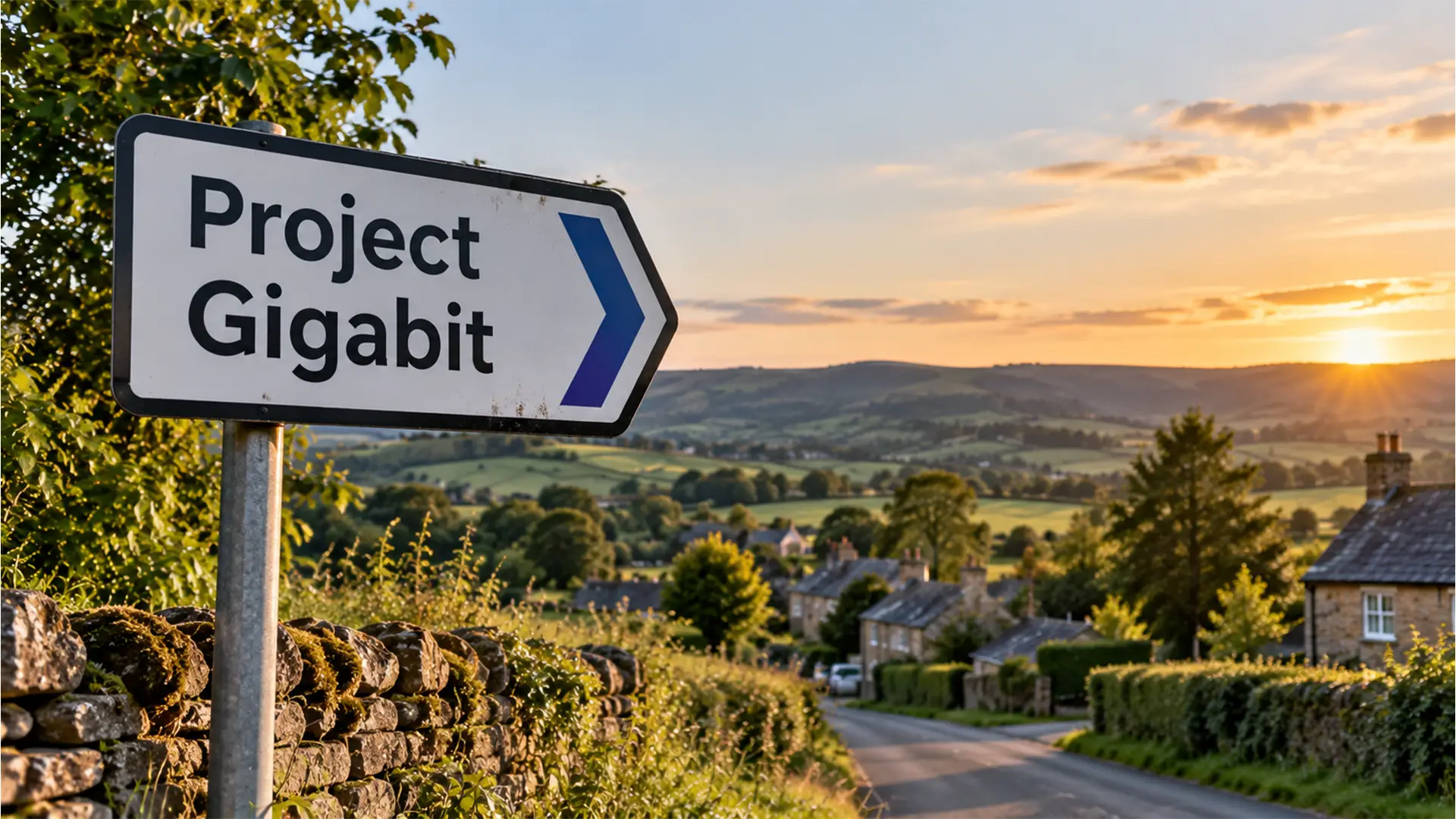
Getting online is easy to take for granted, but faster broadband still hasn't reached every corner of the UK.
While millions of UK homes already have access to gigabit-capable connections, extending faster broadband to rural and harder-to-reach areas can be more challenging and costly for network providers.
That's what Project Gigabit is designed to address.
Project Gigabit is the UK Government's programme to bring gigabit-capable broadband to homes and businesses that may otherwise miss out on commercial broadband upgrades.
It focuses particularly on harder-to-reach areas, using public funding to support broadband infrastructure in places that may otherwise be left waiting for faster connections.
The government is targeting gigabit-capable broadband coverage for at least 99% of UK premises by 2032.
So, what does Project Gigabit mean for your broadband, and how can you find out what's available where you live?
What Is Project Gigabit?
Project Gigabit is a UK Government programme designed to extend gigabit-capable broadband to homes and businesses that are unlikely to be reached through commercial broadband rollout alone.
The programme is delivered by Building Digital UK (BDUK) and uses government funding to support broadband network expansion into areas where building new infrastructure may otherwise be commercially unviable.
The government has committed £5 billion towards interventions for harder-to-reach parts of the country.
Rather than replacing investment from broadband companies, Project Gigabit is designed to fill gaps in commercial rollout and help more of the UK gain access to faster, gigabit-capable connections.
Why Was Project Gigabit Introduced?
Improving broadband in rural and remote areas can be more challenging than in towns and cities.
In a densely populated area, a network operator may be able to connect thousands of homes within a relatively small space.
In rural and remote locations, properties can be much further apart, increasing the cost of extending the network.
This can leave some communities waiting longer for faster broadband.
Project Gigabit uses government funding to support network expansion in areas that are unlikely to receive gigabit-capable broadband through commercial investment alone.
Many of the homes and businesses supported by Project Gigabit are in rural areas, but the programme isn't limited to the countryside. It also covers other areas where gigabit broadband isn't available or planned.
BDUK regularly reviews current and planned network coverage to help determine where public funding may be needed.
What Is Gigabit-Capable Broadband?
A gigabit-capable broadband connection is a wired broadband connection capable of delivering download speeds of at least 1 gigabit per second (Gbps).
That's equivalent to 1,000 megabits per second (Mbps).
There's an important distinction between gigabit-capable broadband and paying for a broadband package that gives you gigabit speeds.
If your property has a gigabit-capable connection, the infrastructure can support speeds of 1Gbps or more. You don't necessarily need to choose a 1Gbps broadband package.
Depending on the providers and packages available at your address, you may be able to choose from different speed options based on how you use your broadband.
Is Project Gigabit the Same as Full Fibre Broadband?
No. Project Gigabit is a government programme, while full fibre is a type of broadband technology.
Full fibre broadband, also known as Fibre to the Premises (FTTP), uses fibre-optic cables running directly to a home or business rather than relying on traditional copper telephone wiring for part of the connection.
Full fibre networks can provide gigabit-capable broadband, but the terms aren't interchangeable.
Put simply, Project Gigabit helps fund the expansion of gigabit-capable infrastructure, while full fibre is one of the technologies that can deliver it.
How Does Project Gigabit Work?
Project Gigabit primarily uses public funding to support broadband network operators building gigabit-capable infrastructure in areas that aren't expected to receive it through commercial investment alone.
BDUK identifies areas where intervention may be needed and broadband suppliers can bid for contracts to extend their networks into those locations.
The government publishes monthly Project Gigabit contract and build updates showing progress across contracted areas.
Before deciding where public funding should be used, BDUK also needs to understand where broadband companies are already building or planning to build.
Its National Rolling Open Market Review process asks suppliers about existing infrastructure and credible build plans over the following three years. These reviews take place three times a year.
This helps direct public funding towards areas that are less likely to be covered commercially.
Where Is Project Gigabit Available?
There isn't one date when Project Gigabit will suddenly become available across the country.
Rollout is taking place through different contracts and projects around the UK, so progress and expected completion dates vary by location.
Some properties already have gigabit-capable broadband through commercial network builds. Others are being covered by Project Gigabit-funded infrastructure, while further areas may be included in future commercial or government-supported plans.
BDUK publishes premises-level Open Market Review and Project Gigabit planning data for people who want to explore the rollout in more detail.
For most households, however, there's a simpler question to answer first: what broadband can I get at my address?
How Can I Check Project Gigabit Coverage in My Area?
Broadband availability can vary from one street or property to another, so checking your individual address is more useful than relying on general coverage figures for your town or county.
You can start with Fusion Fibre Group's Full Fibre Availability Checker to see whether full fibre broadband is available at your address.
For information specifically about government-funded rollout, you can also check the latest Project Gigabit information on GOV.UK.
If full fibre isn't available yet, that doesn't necessarily mean your property won't be covered in the future. Commercial network plans and Project Gigabit builds continue to change as rollout progresses.
Is Project Gigabit the Same as the Gigabit Broadband Voucher Scheme?
No. The Gigabit Broadband Voucher Scheme (GBVS) formed part of the wider Project Gigabit programme, but the two aren't the same thing.
The voucher scheme supported local broadband projects by providing grants worth up to £4,500 per eligible home or business towards the cost of installing gigabit-capable connections.
There has recently been an important change to the scheme.
The Gigabit Broadband Voucher Scheme closed to new voucher project submissions on 31 August 2026.
Existing approved voucher projects can continue, with delivery running until their agreed end dates or the scheme's planned closure on 31 March 2028.
You can find the latest official information on the Gigabit Broadband Voucher Scheme on GOV.UK.
Does Project Gigabit Mean I'll Get 1Gbps Broadband?
Not necessarily.
Project Gigabit is designed to extend gigabit-capable infrastructure. That means the underlying connection can support gigabit speeds, rather than every household automatically receiving a 1Gbps broadband package.
Once gigabit-capable broadband is available at your property, the speeds you can order will depend on the broadband providers and packages available there.
And you may not need 1Gbps.
A busy household with several people streaming, gaming, downloading large files and working from home at the same time will have very different broadband requirements from someone who mainly browses the web and watches TV online.
Choosing the right package is about having enough speed for the way your household uses the internet rather than automatically picking the highest number available.
What Are the Benefits of Gigabit-Capable Broadband?
Speed is the obvious benefit, but having access to gigabit-capable broadband can give households considerably more headroom as their internet use grows.
A faster connection can make it easier for several people to stream, game, video call, work and download files at the same time without competing for limited bandwidth.
Full fibre networks also remove the reliance on copper telephone wiring between the local network and your property, providing a connection designed for today's much heavier internet use.
You don't need to use every bit of available speed from day one. Having gigabit-capable infrastructure at your property gives you more flexibility to increase your broadband speed later if your needs change.
What Does Project Gigabit Mean for My Broadband?
If you already have full fibre available at your address, Project Gigabit may make little difference to the broadband you can order today.
Its biggest impact is on homes and businesses in harder-to-reach areas that may otherwise have waited much longer for gigabit-capable connectivity.
As government-funded and commercial networks continue to expand, more properties should gain access to faster broadband and a wider choice of speeds.
You also don't need to work out whether your property was connected through Project Gigabit, a commercial rollout or another network programme before shopping for broadband.
Start with what's available at your address.
Check Full Fibre Broadband Availability at Your Address
Want to know whether you can get full fibre broadband now?
Pop your postcode into our Full Fibre Availability Checker to see what's available at your property.
If full fibre has reached your address, you can compare the available options and choose a speed that suits the way you use your broadband.
Frequently Asked Questions About Project Gigabit
What Is Project Gigabit?
Project Gigabit is the UK Government's programme for extending gigabit-capable broadband to harder-to-reach homes and businesses that are unlikely to receive connections through commercial rollout alone.
It is delivered by Building Digital UK.
Who Runs Project Gigabit?
Building Digital UK (BDUK) is responsible for delivering Project Gigabit. It works with broadband network operators and uses government intervention to help expand gigabit-capable infrastructure into eligible areas.
You can follow the latest Project Gigabit updates on GOV.UK.
What Speed Is Gigabit Broadband?
Gigabit broadband refers to broadband capable of download speeds of at least 1Gbps, or 1,000Mbps. Having a gigabit-capable connection doesn't mean you have to subscribe to a 1Gbps broadband package.
Is Project Gigabit Only for Rural Areas?
No. Project Gigabit focuses on hard-to-reach properties that aren't expected to receive gigabit-capable broadband through commercial rollout.
Many of these are in rural areas, but whether government intervention is needed depends on existing and planned network coverage rather than simply whether an address is classed as rural.
Is Project Gigabit the Same as Broadband?
No. Broadband is the internet connection you use at your home or business. Project Gigabit is a government programme designed to help extend gigabit-capable broadband infrastructure into harder-to-reach parts of the UK.
Is Project Gigabit the Same as Full Fibre?
No. Project Gigabit is a government programme, whereas full fibre or FTTP is a broadband technology. Full fibre is one way of delivering a gigabit-capable broadband connection.
When Will Project Gigabit Be Completed?
The government is targeting gigabit-capable broadband access for at least 99% of UK premises by 2032. Individual Project Gigabit contracts have their own delivery schedules, so the timing for a particular property will depend on its location.
Can I Still Apply for a Gigabit Broadband Voucher?
The Gigabit Broadband Voucher Scheme closed to new voucher project submissions on 31 August 2026. Existing approved projects continue, with delivery planned until 31 March 2028 or their agreed earlier completion dates.
How Do I Find Out if I Can Get Gigabit Broadband?
Broadband availability is address-specific.
Use our Full Fibre Availability Checker to see what's currently available at your property.
