
A watched kettle never boils.
Neither, it seems, does that giant file you've been trying to move all morning.
The trouble with small delays is that they rarely stay small.
A few extra seconds opening files. A few extra minutes moving data. Repeated across an entire team, the impact can be surprisingly large.
That's why many businesses choose 10 Gigabit Ethernet (10 GbE). It delivers the speed and bandwidth needed to keep data flowing smoothly across the network.
Here's everything you need to know.
What Is 10 Gigabit Ethernet?
10 Gigabit Ethernet (10 GbE) is a networking standard that allows data to be transferred at speeds of 10 gigabits per second (10 Gbps).
That's:
- 10,000 megabits per second
- 10 times faster than traditional Gigabit Ethernet (1 Gbps)
- Capable of transferring around 1.25 gigabytes of data every second under ideal conditions
In simple terms, it allows devices on a network to communicate far more quickly than standard Ethernet connections.
It's commonly used in:
- Data centres
- Business networks
- Server environments
- High-performance workstations
- Video production studios
- Research facilities
- Enterprise storage systems
What Does "Ethernet" Mean?
Ethernet is the technology that keeps wired networks talking.
It's been around for decades and still powers everything from office computers and servers to printers and storage systems.
10 GbE takes that tried-and-tested approach and puts it into a much higher gear, helping data move faster when there's plenty of it to shift.
How Fast Is 10 Gigabit Ethernet?
To understand just how fast 10 Gigabit Ethernet (10 GbE) is, it helps to see where it sits alongside other Ethernet standards.
- 100 Mbps (Fast Ethernet) - Once the standard, now mostly found on older hardware and legacy networks.
- 1 Gbps (Gigabit Ethernet) - The go-to choice for most homes and small businesses.
- 2.5 Gbps - A popular upgrade for ultrafast broadband and high-performance home networks.
- 5 Gbps - Ideal for creative professionals and more demanding workloads.
- 10 Gbps (10 Gigabit Ethernet) - Built for high-speed storage, servers and networks that need exceptional performance.
- 25 Gbps, 40 Gbps and 100 Gbps - Enterprise-grade standards designed for data centres and large-scale infrastructure.
The jump from 1 Gbps to 10 Gbps is a significant one. If your network regularly transfers large files, supports multiple users or handles heavy traffic,.
It's the difference between simply keeping up and having plenty of bandwidth left in reserve. For demanding environments, that extra capacity can make all the difference.
Why Do Businesses Use 10 GbE?
Businesses are moving more data than ever before.
Video calls. Cloud platforms. Shared files. Automated backups. Security systems. It all adds up.
And every bit of it relies on the network keeping pace.
10 GbE provides the extra capacity needed to handle that growing demand, helping data move quickly even when the network is busy.
Faster File Transfers
Large files can move between devices in a fraction of the time, helping teams spend less time waiting and more time getting on with their work.
Some industries feel the benefits more than most:
- Creative agencies
- Video production teams
- Architects
- Engineers
- Software developers
With 10 GbE, jobs that once felt like a good excuse to make a cup of tea can often be finished before the kettle's boiled.
Better Server Performance
Servers rarely have the luxury of serving just one person at a time.
They're often handling requests from dozens, hundreds or even thousands of users simultaneously.
10 GbE provides the bandwidth needed to keep everything running smoothly, helping users get faster access to the applications and data they rely on.
Improved Storage Access
Many organisations use centralised storage systems such as:
- NAS (Network Attached Storage)
- SAN (Storage Area Networks)
Whether it's a video project, design file or database, users can access what they need more quickly across the network.
Future-Proofing
Data usage rarely goes backwards.
Many businesses deploy 10 GbE because it provides room for growth as applications become more demanding.
Where Is 10 GbE Commonly Used?
Data Centres
Data centres rely heavily on high-speed connectivity between:
- Servers
- Storage systems
- Network switches
- Virtual environments
10 GbE became a standard building block for many enterprise environments because it provides strong performance without the cost of even higher-speed solutions.
Video Production
Editing high-resolution video creates enormous files.
Teams working with:
- 4K video
- 6K footage
- 8K production workflows
often use 10 GbE to move content between editing workstations and shared storage.
Virtualisation
Virtual machines generate substantial network traffic.
10 GbE helps support:
- VMware environments
- Hyper-V deployments
- Cloud infrastructure
- Containerised applications
Scientific Research
Research projects have a habit of generating a lot of data.
And by "a lot", we often mean terabytes rather than gigabytes.
10 GbE helps move large datasets between systems quickly and efficiently, so researchers can spend more time making sense of the data and less time waiting for it to arrive.
10 GbE Over Copper vs Fibre
There are two main ways to run a 10 GbE network.
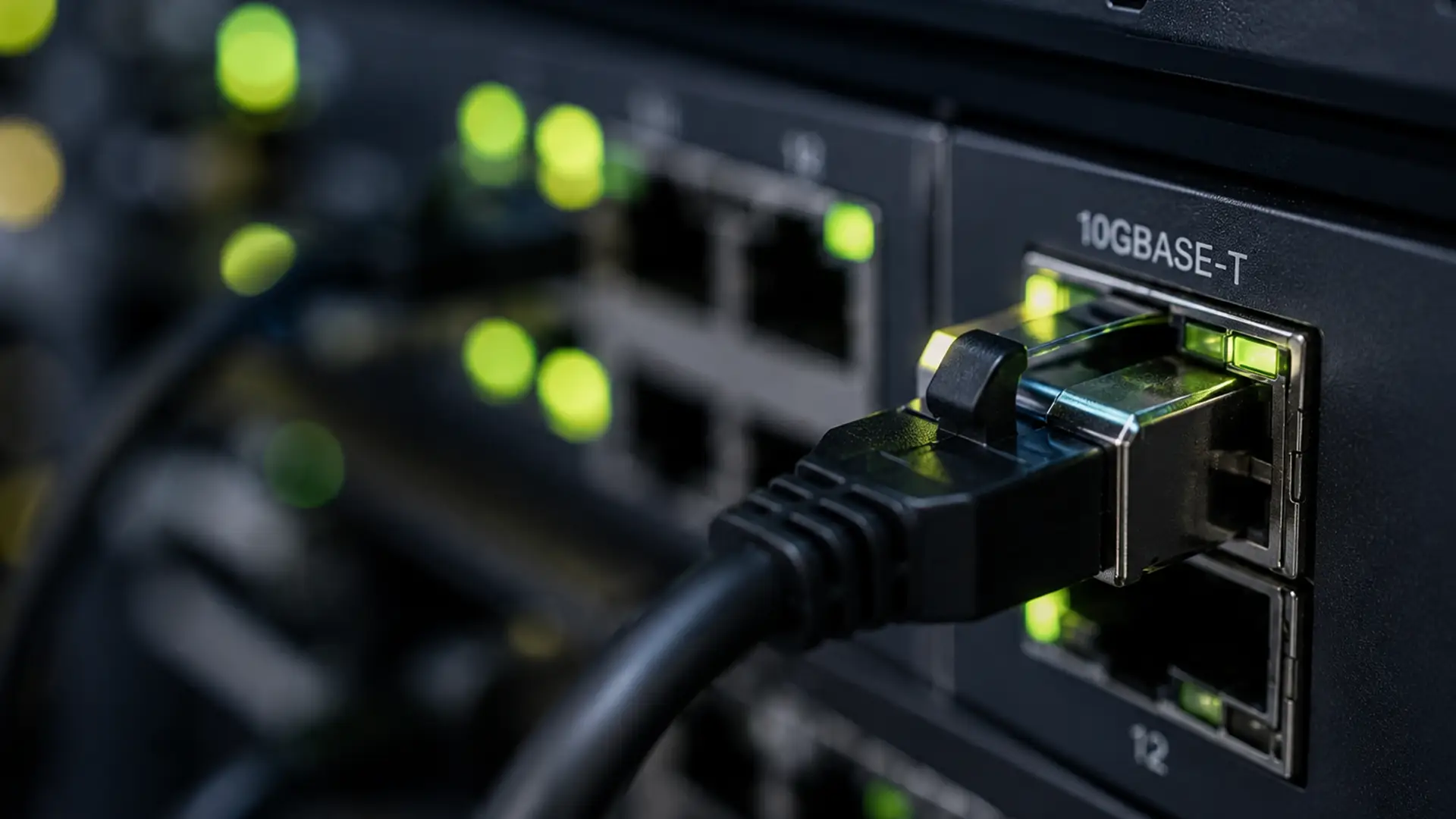
10GBASE-T (Copper)
Uses traditional Ethernet cabling.
Typically supports:
- Cat6
- Cat6a
- Cat7
Advantages include:
- Familiar installation
- Existing Ethernet infrastructure may already be suitable
- Lower complexity
Fibre Optic 10 GbE
Uses optical fibre rather than copper cabling.
Benefits include:
- Longer transmission distances
- Reduced electromagnetic interference
- Extremely high reliability
Fibre is often preferred in larger buildings, campuses and data centres.
What Equipment Do You Need for 10 GbE?
A complete 10 GbE network usually requires:
- 10 GbE Network Cards (NICs): Devices need network adapters capable of supporting 10 Gbps speeds.
- 10 GbE Switches: The network switch must also support 10 Gigabit connections.
Suitable Cabling
Depending on the setup, this could include:
- Cat6a Ethernet cable
- Cat7 cable
- Fibre optic cable
Compatible Devices
Every part of the connection needs to support 10 GbE if you want to achieve full speeds.
A single Gigabit-only device will still operate, but it'll be limited to its maximum supported speed.
Is 10 GbE the Same as a 10 Gig Internet Connection?
Nope. The names are similar enough to trip anyone up, but they're talking about two different parts of your setup.
10 GbE
Refers to the speed of a local network connection between devices.
For example:
- PC to server
- Server to storage
- Workstation to switch
10 Gig Internet
Refers to the speed of your internet connection provided by an ISP.
You can have:
- A 10 GbE local network with a 1 Gbps internet connection
- A multi-gig internet connection without a 10 GbE internal network
- Both working together
Do Small Businesses Need 10 GbE?
Not always.
Many businesses still operate perfectly well using Gigabit Ethernet.
However, 10 GbE becomes increasingly valuable when:
- Multiple users access shared storage
- Large files are transferred regularly
- High-performance applications are used
- Network congestion is becoming noticeable
- Growth is expected over the next few years
When large files are part of the daily routine, those performance gains soon start adding up.
Advantages of 10 Gigabit Ethernet
- Speed: Transfers data up to ten times faster than standard Gigabit Ethernet.
- Reduced Network Congestion: More bandwidth means more room for traffic.
- Better Productivity: Less waiting for files to upload, download or move across the network.
- Scalability: Supports growing workloads and increasing data demands.
- Reliable Wired Performance: Unlike wireless networks, Ethernet provides consistent, predictable performance.
Potential Drawbacks
Like any technology, there are considerations.
- Higher Hardware Costs: 10 GbE switches, adapters and compatible infrastructure can cost more than standard Gigabit equipment.
- Infrastructure Upgrades: Older cabling may need replacing.
- Not Always Necessary: If your workloads are relatively light, the benefits may be difficult to notice.
The key is matching network capability to your actual business needs.
The Future of Ethernet Speeds
While 10 GbE remains widely deployed, network technology continues to evolve.
Many enterprise environments are now adopting:
- 25 GbE
- 40 GbE
- 100 GbE
- 400 GbE
Even so, 10 Gigabit Ethernet remains a sweet spot for many organisations because it delivers substantial performance improvements without the complexity or cost of ultra-high-speed deployments.
Final Thoughts
10 Gigabit Ethernet bridges the gap between traditional networking and the demands of modern business infrastructure.
It offers significantly faster data transfers, improved performance for servers and storage systems, and the capacity to support growing workloads without constant upgrades.
For organisations handling large files, virtual environments or data-intensive applications, 10 GbE can make everyday tasks feel dramatically quicker.
And while 10 Gbps might sound excessive at first glance, today's data-heavy workplaces have a habit of catching up with tomorrow's network speeds surprisingly fast.
Frequently Asked Questions
What Does 10 GbE Stand For?
10 GbE stands for 10 Gigabit Ethernet, a networking standard capable of transferring data at speeds of up to 10 gigabits per second.
Is 10 GbE Faster Than Gigabit Ethernet?
Yes. 10 GbE is ten times faster than standard Gigabit Ethernet (1 Gbps).
Can I Use Existing Ethernet Cables for 10 GbE?
In some cases, yes. Many 10GBASE-T deployments use Cat6 or Cat6a cabling, although performance depends on cable quality and distance.
Is 10 GbE Worth It?
For businesses moving large amounts of data, using shared storage, or supporting demanding applications, 10 GbE can deliver noticeable performance improvements.
Does Wi-Fi Support 10 Gbps?
Some modern Wi-Fi standards can theoretically reach multi-gigabit speeds, but real-world performance typically varies. Wired 10 GbE connections remain more consistent and reliable for demanding workloads.
